

The Rakytovce cadastral area
An area at the junction of the Zvolen Basin and the Kremnica Hills – where the floodplain of the Hron River meets the Mesozoic rocky hills.
Explore the local area
Choose a topic – location, topography, water, climate or old place names.
The area between the Hron and the Kečka
The area stretches from the Hron River to Kečka Hill – it takes 7 km to walk all the way round it.
- the highest point is about 475 m
- lowest point 318 m
- 2.4 × 1.8 km
- circumference 7 km
Full text
The northernmost point of the cadastral area lies in the Rakytovská Valley at the junction of the cadastral boundaries of Badín, Kremnička and Rakytovce, near the Kečka quarry. On the Kečka ridge, the boundary reaches its westernmost point and turns south-east, where it reaches its highest point at an altitude of approximately 475 m.
It runs through the valley between Kečka and Krásny vršok to the edge of the woodland and descends past Kolónia Baňa into the valley of the Vlkanovský stream. Just before the football pitch fence, the boundary line leaves the stream and, running along the edge of the lay-by, crosses the fields to the locality of Čierne blato. At its lowest point, at an altitude of 318 metres above sea level, it runs parallel to the main road to the left bank of the River Hron.
The westernmost and easternmost points are 2.4 km apart as the crow flies, and the northernmost and southernmost points are 1.8 km apart. If we were to walk all the way round the Rakytovce district, it would be exactly 7 kilometres.
Geological structure and relief
The eastern part lies in the Sliač Basin on the River Hron, whilst the western part lies in the Bystrica Valley beneath the Kremnica Hills.
- The Zvolen Basin
- Kečka 497 m
- andesites, limestones, dolomites
Full text
Geomorphologically, the entire cadastral area lies within the Zvolen Basin – an intramountain depression in the Inner Western Carpathians. The eastern half of the cadastral area, on the banks of the Hron, forms part of the Sliač Basin sub-unit, whilst the western half – predominantly forested and rugged – lies in the Bystrica Valley at the foot of the Kremnica Hills.
The cadastral area consists mainly of volcanic and carbonate rocks. On the Hron floodplain, where the built-up area is concentrated, the surface consists of Neogene rocks – clays, sands and gravels. The transition between the basin and the volcanic massif is formed by a mixture of volcanic and carbonate rocks.
The north-western tip of the cadastral area is formed by Mesozoic rocks – sandy limestones, radiolarites, variegated clay shales and Triassic dolomites. The Kečka limestone deposit lies here. Kečka Hill (497 m above sea level) lies on volcanic rocks – pyroxene andesites – which are among the older stratovolcanoes of central Slovakia.
“Rock formations emerge at the surface in the Rakytovská Valley, where the Rakytovský Stream has carved a gorge on the right bank, with a small cliff rising above the site of the former Rakytovský mill.”
The River Hron and the streams within the parish boundaries
The main feature of the cadastral area is the Rakytovský stream, which flows into the Hron after a journey of just under 7 km.
- The River Hron within the cadastral area: 280 m
- The Rakytovský Stream, just under 7 km
- record of 560 m³/s (1974)
Floods on the Hron
Floods affecting the Rakytovce area were recorded in 1784, 1813, 1853 and 1974. A maximum flow rate of 560 m³/s was recorded on 22 October 1974 at a water level of 494 cm.
Full text
Hydrologically, the area falls within the Hron river catchment, which flows through the cadastral area along its eastern edge for a distance of 280 metres. The drainage conditions are typical of a highland-lowland area with a snow-rain climate – the highest flow is in March (from melting snow) and the lowest in September.
The main feature of the cadastral area is the Rakytovský stream – a right-bank tributary of the Hron, historically also known as the Báčovský jarok, Krmník or Potok Hrenocz. It rises in the Kremnické vrchy hills below Vysočina (859 m above sea level) and, after a distance of just under 7 km, flows into the Hron. It flows south-east through a predominantly wooded valley, passing the Kečka quarry, and runs through a regulated channel around the cooperative’s premises.
Other streams include Potôčok (a seasonal stream draining the centre of Rakytovce) and Vlkanovský potok, locally known as Kriedovický jarok, which flows past the hamlet of Kolónia Baňa and the football pitch.
The climate of Rakytovce
Warm to moderately warm region – the valley experiences 80 to 100 foggy days a year.
The climate in figures
- 8,0 °Caverage annual temperature
- −3,7 °Caverage for January
- 18,2 °Caverage for July
- 700 – 900 mmannual rainfall
- 60 – 80 dayssnow cover
- 1 700 – 1 800 hsunshine hours per year
Full text
The district lies on the border between the warm and moderately warm climatic regions of Slovakia. The area on the Hron floodplain belongs to a warm, moderately humid climatic region with mild winters. The remainder of the district to the west falls within a moderately warm but very humid highland zone.
The nature of the weather is determined by the location within an intermontane depression surrounded by the Western Carpathian mountain ranges, where inversion conditions frequently occur – foggy weather, smog and the accumulation of cold air in the basin. On average, 80 to 100 days of fog are recorded, which is roughly a quarter of the calendar year.
Place names and historical names
Rakytovce was established from the Badín district in 1295. Over the centuries, the stream has been known as Hrenocz, Krmník and Rakytov Bach.
- 1295 – first mention
- Upper and Lower Rakytovec
Names of the Rakytovský Stream
- 1295Potok Hrenocz (Chrenovec)
- 1655Krmník
- 1876Rakytovský potok
- 1884Rakytov Bach
- 1900Rakolczi p.
- todayRakytovský potok
The oldest name, Hrenocz (Chrenovec), was derived from the horseradish growing on the banks of the stream. The name Krmník comes from the appellative ‘krmník’ – a cattle shed – perhaps because of the stream’s location, as it flowed past the cattle sheds.
Full text
The territory of Rakytovec was separated from the Badín district by a royal grant in 1295. The name Rakytovec is mentioned in the titles of local noblemen from the mid-14th century. Before 1467, there was Horný Rakytovec and the smaller Dolný Rakytovec.
What grows and lives here
Trees, plants, fungi and animals found in the local area. Search by Slovak or Latin name, or choose a category.

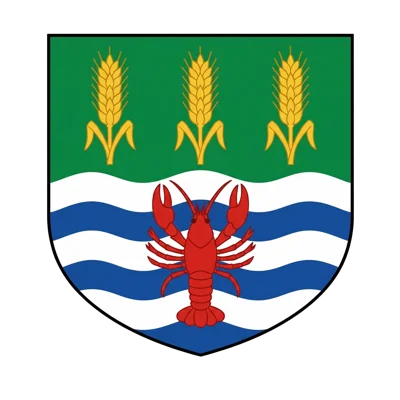
The crab in the Rakytovce coat of arms
As recently as 2015, two river crayfish (Astacus astacus) were spotted in Banský jarok, near the football pitch. The crayfish is the symbol of Rakytovce – although the actual origin of the village’s name comes from the plant ‘rakyta’ (Salix caprea), the goat willow, which still grows commonly along the local streams to this day.
-
European beech
Fagus sylvatica
Trees and shrubs
-
Sessile oak
Quercus petraea
Trees and shrubs
-
European hornbeam
Carpinus betulus
Trees and shrubs
-
Silver birch
Betula pendula
Trees and shrubs
-
Scots pine
Pinus sylvestris
Trees and shrubs
-
Norway spruce
Picea abies
Trees and shrubs
-
Goat willow
Salix caprea
Trees and shrubs
-
Common hazel
Corylus avellana
Trees and shrubs
-
Dog rose
Rosa canina
Trees and shrubs
-
Cornelian cherry
Cornus mas
Trees and shrubs
-
Cowslip
Primula veris
Herbs
-
Common dandelion
Taraxacum officinale
Herbs
-
Wood anemone
Anemone nemorosa
Herbs
-
Common sage
Salvia officinalis
Herbs
-
Peppermint
Mentha piperita
Herbs
-
St John's wort
Hypericum perforatum
Herbs
-
Summer cep
Boletus reticulatus
Mushrooms
-
Chanterelle
Cantharellus cibarius
Mushrooms
-
Aspen bolete
Leccinum albostipitatum
Mushrooms
-
Parasol mushroom
Macrolepiota procera
Mushrooms
-
Wild boar
Sus scrofa
Mammals
-
Roe deer
Capreolus capreolus
Mammals
-
Red deer
Cervus elaphus
Mammals
-
Red fox
Vulpes vulpes
Mammals
-
Brown bear
Ursus arctos
Mammals
-
European badger
Meles meles
Mammals
-
Red squirrel
Sciurus vulgaris
Mammals
-
Grass snake
Natrix natrix
Reptiles and amphibians
-
European green lizard
Lacerta viridis
Reptiles and amphibians
-
Fire salamander
Salamandra salamandra
Reptiles and amphibians
-
Common buzzard
Buteo buteo
Birds
-
Tawny owl
Strix aluco
Birds
-
Great spotted woodpecker
Dendrocopos major
Birds
-
White stork
Ciconia ciconia
Birds
-
Barn swallow
Hirundo rustica
Birds
-
Common cuckoo
Cuculus canorus
Birds
-
Old World swallowtail
Papilio machaon
Insects
-
Clouded Apollo
Parnassius mnemosyne
Insects
-
Seven-spot ladybird
Coccinella septempunctata
Insects
-
Rose chafer
Cetonia aurata
Insects
We couldn't find anything. Please try a different name or group.
More about flora and fauna
Vegetation of the cadastral area
The partially deforested area outside the village consists of permanent grassland – meadows, pastures and hayfields. The remainder is covered by mixed forests comprising beech, pine, oak, spruce, birch and other forest trees. Phytogeographically, the area belongs to the Holarctic region, the Euro-Siberian subregion and the Central European province.
Beech forests are the dominant tree species in the submontane beech vegetation zone. Among the old trees within the village boundaries are three massive lime trees in the village cemetery. Outside the built-up area, a striking solitary cherry tree grows in a meadow between Krásny vršek and the cemetery – a tree of imposing stature, forming a picturesque feature of the landscape.
Fauna of the local area
The animal kingdom is represented by fauna characteristic of the Carpathian foothills and mountainous regions. The cadastral area comprises a mosaic of animal communities inhabiting forests, scrubland, rocky areas, meadows, pastures, fields, water bodies and gardens within the built-up area.
Protected areas in the surrounding area
There are no specially protected areas within the Rakytovce cadastral area itself. However, there are several sites of conservation importance in neighbouring cadastral areas:
- 4 km from the centre of the village
Kremenná jaskyňa
A pseudokarst cave.
Protection level 4 - 4,2 km from the centre of the village
Malachovské skalky
Thermophilic plants and animals.
Protection level 4 - 4,3 km from the centre of the village
Kozlinec
An isolated occurrence of the downy oak.
Protection level 5 - 5,5 km from the centre of the village
Badínsky prales
Primeval beech forests.
Protection level 5
Find out more about Rakytovce
Detailed information about the natural environment and the municipal area can be found in the monograph *Rakytovec: A Town with Seven Streets* by M. Pecník and V. Luptáková (2015).